

Off-Grid Solar System in Lucknow
Complete energy independence. A standalone solar power system with battery storage that runs your home, farm or shop entirely on its own — no grid connection required, no electricity bill at all.
- Zero Electricity Bill
- Works Without Grid
- Battery Backup Included
- Installed Across UP
What Is an Off-Grid Solar System?
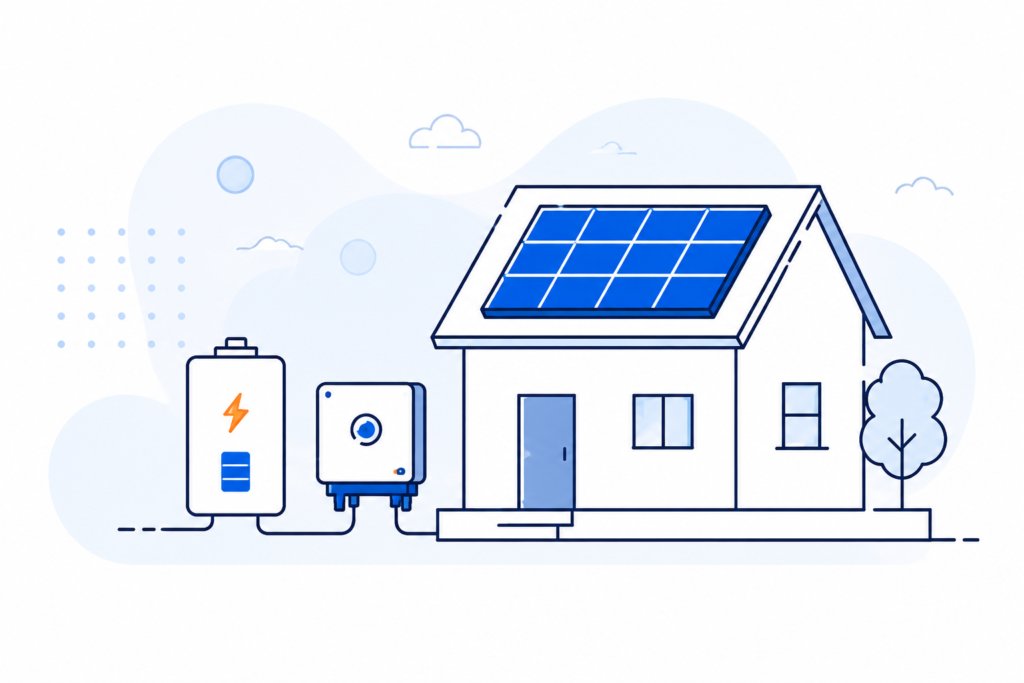
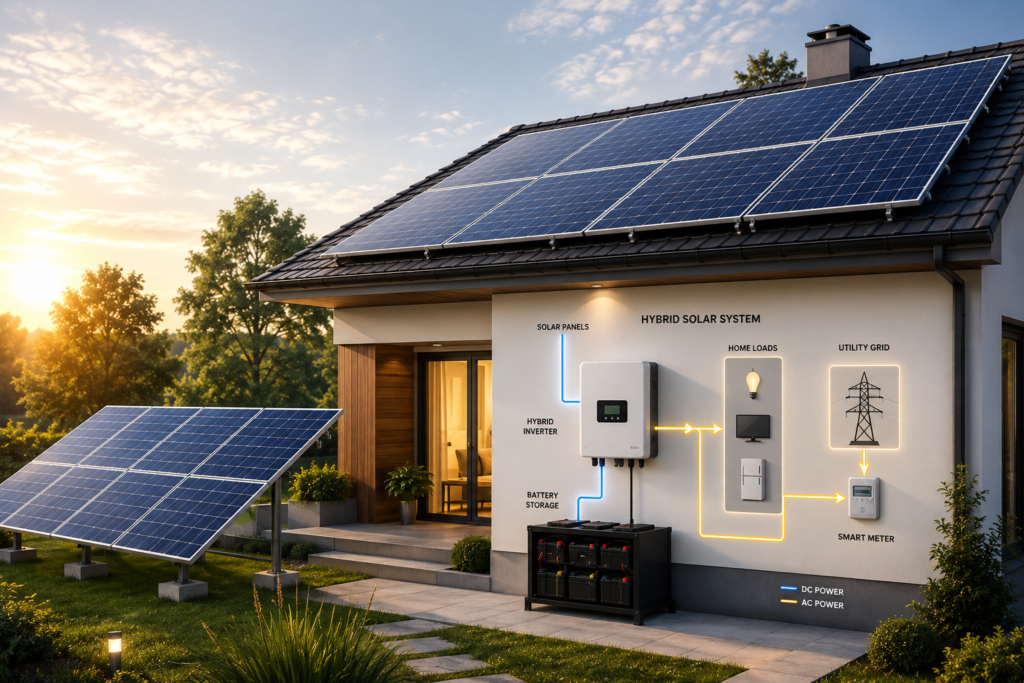
An off-grid solar system is a completely self-contained power plant. Solar panels generate electricity during the day; a battery bank stores what you don’t immediately use; and a solar inverter (also called a PCU) delivers power to your appliances around the clock.
There is no connection to MVVNL or any DISCOM. No net meter, no monthly bill, no dependence on when the grid feels like supplying power.
This is the right system where the grid is absent, unreliable, or prohibitively expensive to extend — farmhouses, agricultural plots, rural homes, remote shops, construction sites, telecom towers, and properties on the outskirts of Lucknow where the line simply hasn’t reached.
No Battery
Works with MVVNL
Earn Credits
Lower Electricity Bills
How an Off-Grid System Works

Panels generate DC power
during daylight hours.

A charge controller (MPPT)
regulates that power and charges the battery bank safely.

The battery stores surplus energy
for use at night and on cloudy days.

The off-grid inverter converts DC to AC
running your fans, lights, pump, fridge and other appliances.

Everything runs independently
the system never touches the utility grid.
Why Homes and Farms AcrossUttar Pradesh Choose Off-Grid Solar

Complete Freedom From the DISCOM
No bills or tariff hikes. Enjoy complete freedom with reliable off-grid solar power.
Power Where the Grid Doesn't Reach
Reliable solar power for remote farms and properties beyond the electricity grid.

Immune to
Outages
Stay powered during outages with solar that works independently from the grid.

Runs Agricultural
Loads
Reliably power pumps, tubewells and essential farm equipment with off-grid solar.

No Diesel Generator Costs
Replace costly diesel generators and save on fuel, servicing and operating costs.
What You Should Know Before Choosing Off-Grid
We would rather you buy the right system than the expensive one. Off-grid isn’t for everyone:
If your property has a working grid connection, a hybrid system almost always beats off-grid — you get the same backup, plus net-metering credits and subsidy eligibility.
- It costs more upfront. The battery bank typically adds 40–70% to the cost of an equivalent-sized on-grid system.
- Batteries need replacement. Lead-acid tubular batteries last 4–6 years; lithium (LFP) batteries last 8–12 years but cost more initially.
- No subsidy on most off-grid residential setups. The PM Surya Ghar central subsidy is designed for grid-connected residential systems. Some off-grid applications qualify under separate MNRE or state programmes (particularly solar pumps under PM-KUSUM) — we will tell you honestly what applies to your case.
- Surplus power is wasted. Once the batteries are full, extra generation has nowhere to go. There is no export credit.
- Sizing must be exact. If the system is undersized, you run out of power at night. We size against your actual load list, not a guess.
Off-Grid Solar System Price in Lucknow (2026)
Indicative pricing for a complete system — panels, MPPT charge controller, off-grid inverter/PCU, battery bank, mounting structure, wiring, protection and installation.
|
System Size
|
Battery Backup
|
Runs
|
Approx. Cost (Tubular)
|
Approx. Cost (Lithium)
|
|---|---|---|---|---|
|
1 kW
|
||||
Cost depends heavily on the battery chemistry and backup hours you need. Tubular batteries are cheaper upfront; lithium is cheaper over 10 years. We’ll show you both numbers side by side.
Where Off-Grid Solar Works Best

Farmhouses &
Rural Homes
Full home power in villages around Lucknow, Barabanki, Sitapur, Unnao and Hardoi where supply is patchy or absent.

Agricultural Pumps & Tubewells
Solar-powered submersible and surface pumps that run when you need to irrigate — not when the DISCOM decides to supply power. Ask us about PM-KUSUM eligibility.

Shops & Small
Commercial Units
Roadside shops, dhabas, godowns and small units on the city outskirts that need reliable daytime power without a heavy commercial tariff.

Construction Sites &
Temporary Setups
Portable and semi-permanent installations that avoid diesel generator running costs entirely.
Telecom Towers &
Remote Infrastructure
Unmanned sites requiring 24×7 uptime with no grid access.

Rural Schools, Clinics &
Community Buildings
Reliable lighting, fans, computers and cold-chain refrigeration in locations the grid serves poorly.
Choosing Your Battery — Tubular vs Lithium
|
Features
|
Tubular Lead-Acid
|
Lithium (LFP)
|
|---|---|---|
Our honest recommendation:
if you can stretch the upfront budget, lithium works out cheaper over the life of the system and gives you far more usable backup per rupee. If cash flow is the constraint, a good tubular bank is perfectly reliable — it just needs the water topped up.
What's Included in an Umangot Off-Grid Installation
|
Component
|
Specification
|
|---|---|
Typcial Timeline
10-15 days
for installation
30-60 days
for net meter and subsidy disbursal
How We Size Your Off-Grid System
Undersizing is the most common failure in off-grid solar, and it’s always a sizing mistake, not a product fault. Our engineer builds a full load table on the site survey:

List Every Appliance
Note quantity, wattage and daily usage of every appliance

Calculate Energy Need
Calculate your total daily electricity requirement in kilowatt-hours.

Plan Backup Days
Decide how many cloudy days the system needs to support.
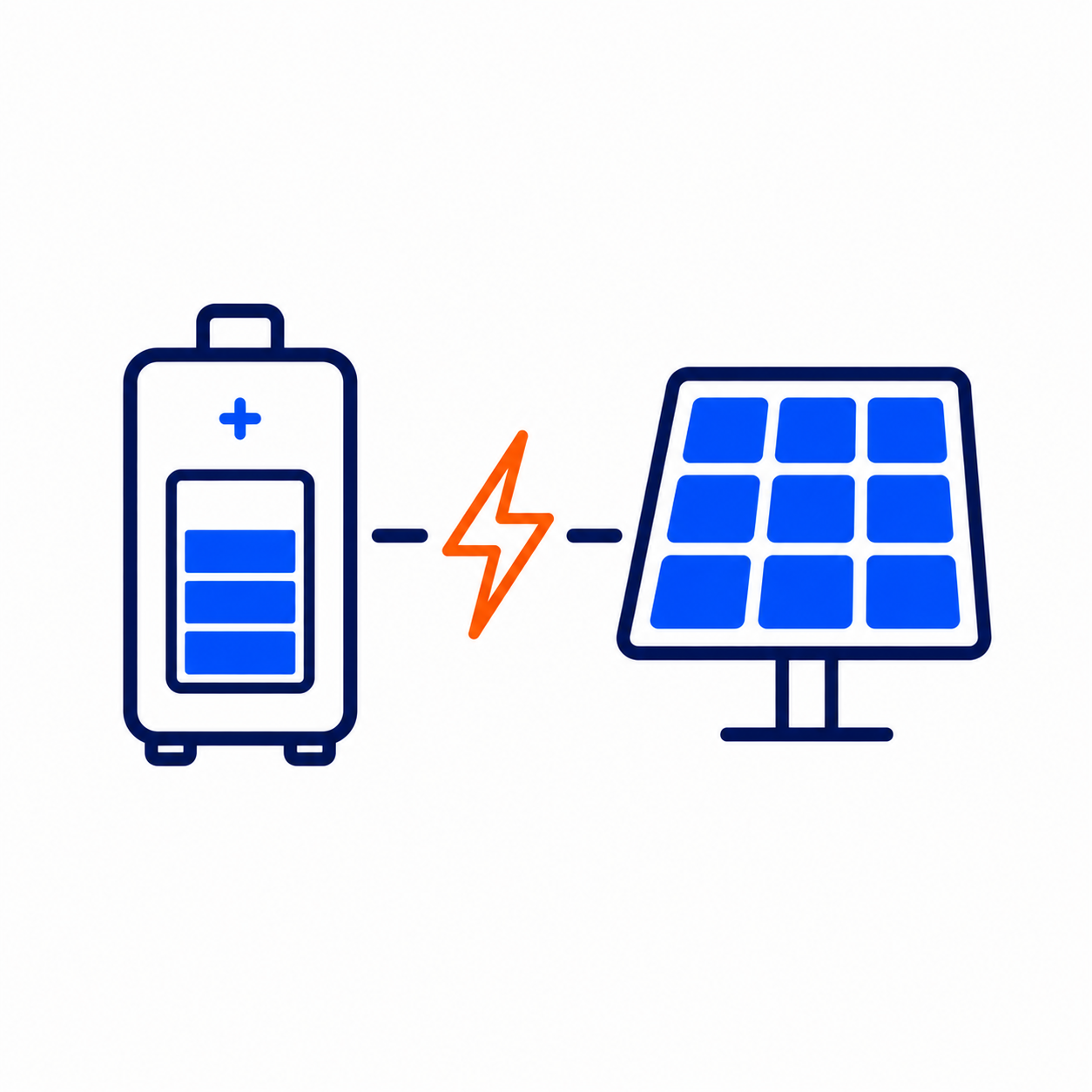
Size Battery & Panels
Size the battery storage and solar array for reliable daily backup.
Size the Inverter
Choose the inverter for peak load with extra capacity for motor surge.
Off-Grid Solar System — Frequently Asked Questions
Yes, with the right sizing. A 1.5-ton inverter AC draws roughly 1,200–1,500W while running. Running it for 6–8 hours needs around 10 kWh of stored energy, which means a substantial battery bank. It’s entirely doable — it just needs to be planned properly and priced honestly, which is why we build the load table before quoting.
The PM Surya Ghar central subsidy applies to grid-connected residential systems, so most off-grid home installations do not qualify. Solar agricultural pumps may qualify under PM-KUSUM, and some institutional and rural applications have separate MNRE or UPNEDA support. We check your specific case and tell you what genuinely applies — we don’t promise subsidy that isn’t there.
Tubular lead-acid batteries typically last 4–6 years with proper maintenance. Lithium LFP batteries last 8–12 years with no maintenance. Battery life depends heavily on how deeply you discharge them daily, which is why correct sizing matters so much.
The panels still generate, just at reduced output — typically 20–40% of a clear day. We size the battery bank with 1–2 days of autonomy so you ride through short spells. For extended cloudy periods, a hybrid system with grid or generator backup is the safer design if you have that option.
Yes, if the system is designed for it. Tell our engineer during the survey that you plan to expand, and we’ll specify an inverter and charge controller with headroom so expansion is a simple addition rather than a replacement.
Around 80–100 sq ft per kilowatt of panels, plus a dry, ventilated space for the battery bank and inverter. Ground-mounted arrays are common for farm installations where roof space is limited.
Slightly. Panels need the same fortnightly wash. Tubular batteries additionally need distilled water topped up every 2–3 months and terminals kept clean. Lithium batteries need nothing. Our 5-year free service covers scheduled visits.
Wash the panels with plain water every 15 days, more often during dusty months and after Diwali. Beyond that, an annual service check. Umangot includes 5 years of free service.
Our Recent Projects
Trending Stories

Trending Stories
Trending Stories
🌱 Start Project
Upgrade your home's power sourcewith On-Grid Solar System
Enhance your home with on-grid solar systems. Enjoy abundant, clean energy while increasing the value of your property. Explore our residential solar solutions now!


© 2026 Umangot Solar. All rights reserved.